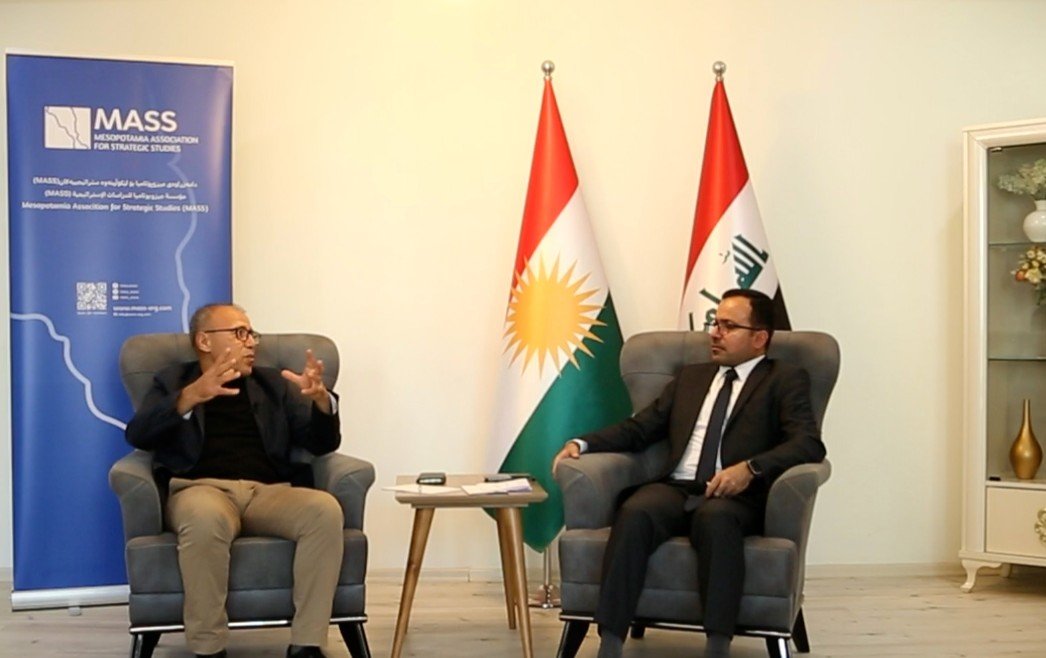


End of the post-uprising regime
Dr. Yousef Mohammed
what happened
It is almost two months since the decision of the Federal Supreme Court of Iraq on May 30 and about a month since the implementation of the decision. This incident was interpreted as much simpler than it was, while the fact is that if the closure of parliament by coup in October 2015 was the closure of the door to any reforms and changes in governance after the uprising The uprising rules the region. The closure of parliament should be read in the context of what is happening since 1991, not as an isolated event.
The Kurdistan Region was established as a de facto government in 1991-1992 on two main foundations: one was the popular will to reject the Ba’ath regime, which was best expressed in the revolution. The second was the support of the international community for the Kurdish cause in South Kurdistan after the revolution, which led to Resolution 688, the Provide Comfort Project and the no-fly zone. In addition, the decision of the then Baghdad regime
In the autumn of 1991, the withdrawal of the armed forces and its administration from the Kurdistan Region helped the Kurds fill the security and administrative vacuum with their own institutions.
Now both factors are completely weakened. The majority of people no longer believe in this governance, and the best evidence for this is the absence of the majority of voters in the last elections and the continuous trend of citizens to flee from the failed governance of the region. At the level of the international community, the friends of the Kurdish people are rightly tired of the governance of the region and according to some specific information, they no longer care about the fate of this governance. If we consider another factor, which is the state’s embeddedness in the international system and the lack of influence of non-state actors, unlike in 1991 after the collapse of the Soviet Union, this will again be another factor in reducing support for the region.
Where do we stand now?
The Kurdistan Regional Government (KRG) authorities have not been able to institutionalize the governance of the region and instead of democratic legitimacy and the voice of the people, they still rely on revolutionary legitimacy (although what is said and written about the mountain struggle). This is the main source of the region’s successive failures
In summarizing the intensity of the events of the past 31 years under the shadow of the Kurdistan Regional Government experience, we can say that two of the events of the past 31 years in particular had a decisive impact on the failure of the experience. as:
1. Fifty-fifty rule between the PUK and KDP;
2. The suicide civil war between these two forces, which brought the Iraqi army to the national dignity of the Kurdish people.
The turning point in the retreat of the Kurdistan Regional Government was the failure of the referendum and the subsequent loss of more than half of Kurdistan’s territory on October 16, 2017. Massoud Barzani, those who supported him, and most of the dominant caste of mountain revolutionaries, even some of those in opposition at the time, did not understand the issue of annexation
The Kurds of the south within the framework of the province of Mosul to Iraq and stay there is an international and regional issue as much as an internal issue of Iraq!
This uncalculated and illegal gamble, which has no legal and official documents to approve it even at the regional level, not only did not lead to independence, but also led to a series of successive defeats that began with the approval of the Federal Supreme Court.
Since then, the region has gradually lost its de facto powers and has been opened up to the so-called constitution and even less of its constitutional rights.
The failure of the so-called “independent economy” (more dependent on oil and then on Turkey) and the forced handover of oil after losing the opportunity to reach a balanced agreement with Baghdad further shaken the foundations of the current governance.
Therefore, we can conclude without hesitation that after all these failures, the decision of the Federal Supreme Court on the unconstitutionality of extending the term of parliament was the end of the undemocratic and unconstitutional governance of the region The region, not the stage of continuous renewal of the legitimacy of the region’s governance.
Therefore, the legitimacy of this regime has ended and any attempt to continue it will lead to the collapse of the region.
What can be done, what is the solution?
It is time for all the benefactors of the region to gather around a project to establish a new system of governance in the region that citizens and guaranteeing their rights, especially providing them with jobs and a dignified life, is the core of the system. This requires the following steps (these are some basic points, otherwise there are other necessary steps that the faithful can add):
First, at the level of the governance system:
1. Separate all armed, security and intelligence forces from the parties and hand them over to the allies to rebuild a strong national force at all levels, such as rebuilding the Iraqi army and security forces;
2. Holding clean and credible elections in the Kurdistan Region for a parliament whose task is to write the constitution of the region and then dissolve it and hold elections;
3. Seriously review the judiciary and make it independent from party, personal and government interference through a comprehensive project.
4. Establish a national economy based on the banking of the region’s entire finances and put an end to any looting of public revenue;
Second: At the level of Iraq and abroad:
An agreement with Baghdad based on economic integration, ending the false war on both sides and resolving issues through the constitution will strengthen the region.
Despite the continued problems with Baghdad, the Kurdish issue within Iraq has advanced much more than other parts of Kurdistan, so instead of being a burden to neighboring countries, an agreement with Baghdad is less taxing. For Iraq, compromise for the region to resolve the problems is much less costly than compromise abroad, such as the Algiers agreement.
A developed region within Iraq will strengthen its role in neighboring countries and internationally.
At the same time, work must be done to correct the course of governance in Iraq to free it from central rule, corruption and bad governance.
These steps will create new hope for the revival and establishment of a modern governance that can face all the challenges that come before it. There is now a historic need to establish a new model of governance that is worthy of the struggle and sacrifices of the Kurdish people, and this solution must be achieved through the joint work of national and indigenous forces and groups
 Previous Post
 Next Post